



Beyond the Paper Jam: How Telecopier's Premium Refurbishing Standards Keep Ricoh Fleets Running
Ricoh copier refurbishing plays a critical role in extending equipment lifespan while maintaining reliable office printing performance. Many businesses assume that refurbished machines are less dependable than new models, but the quality of the refurbishment process often determines long-term reliability.
A professionally refurbished Ricoh copier undergoes extensive inspections, replacement of worn components, system testing and quality assurance checks before returning to service. When completed to high standards, refurbished equipment can deliver exceptional value while helping businesses reduce costs.
In this article, we explore how Ricoh copier refurbishing helps keep office fleets operating efficiently and why refurbishment quality matters more than many businesses realise.
The Step-by-Step Anatomy of an Engineering-Grade Copier Rebuild
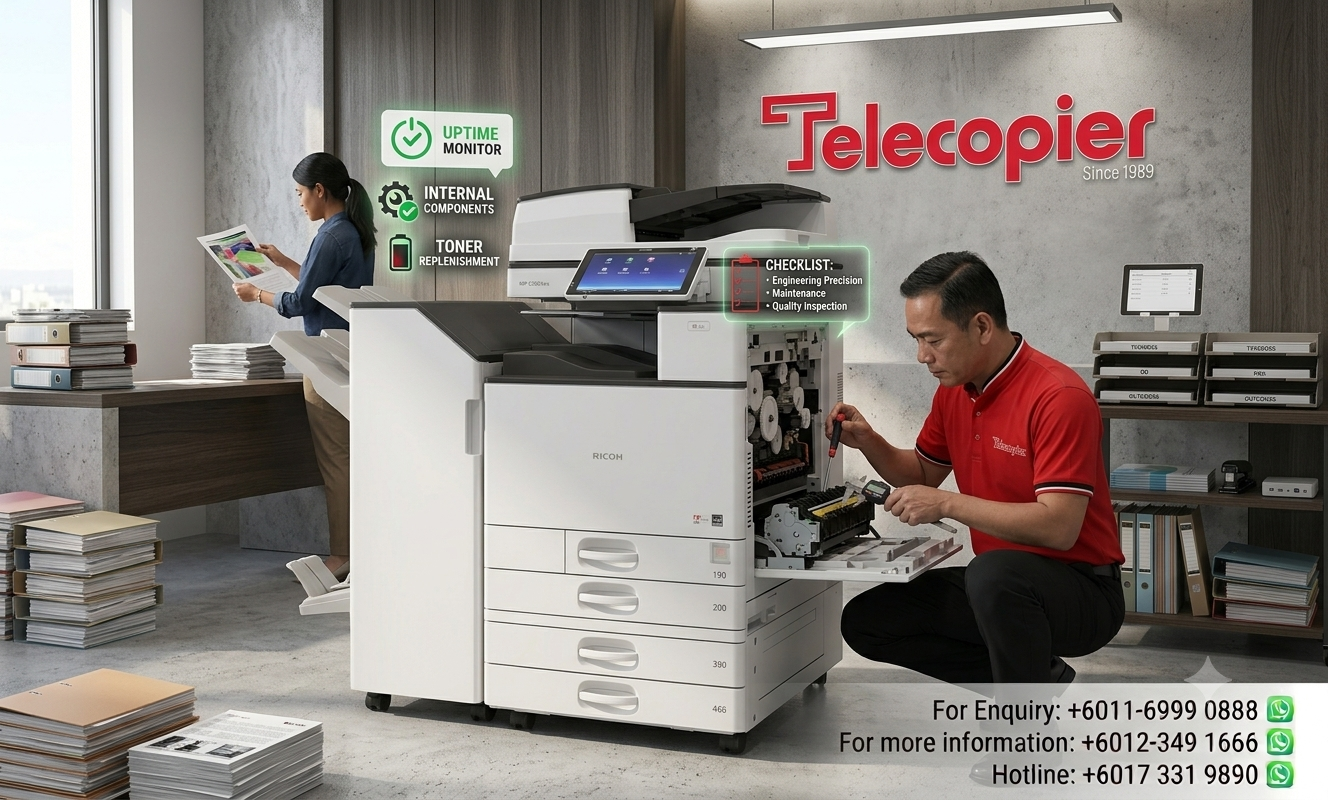
Our premium refurbishing lifecycle begins with an exhaustive mechanical teardown conducted by factory-certified service technicians. Every Ricoh machine entering our facility is stripped down to its core structural metal chassis. This deep teardown allows our engineers to carefully inspect all internal components for signs of fatigue, structural stress, or wear. We utilize advanced anti-static vacuums to clear out built-in paper dust, residual toner powder, and environmental grime from the internal gears and circuit bays, returning the internal environment to factory-clean standards.
Next, rather than simply cleaning worn components, we follow a strict replacement policy for high-wear parts. Every rubber paper pick-up roller, feed roller, and separation pad is completely replaced with brand-new OEM components to prevent double-feeding issues and paper jams. Critical internal assemblies—including the high-heat fuser rollers, image drum units, developer units, and laser scanner mirrors—are meticulously cleaned, tested for precision, and re-calibrated. Any component that fails to meet our strict performance metrics is replaced immediately, ensuring crisp text clarity and consistent output across every single page.

Laser Calibration and Electronic Optimization Subsystems
Beyond the heavy mechanical gears and feed rollers, a modern Ricoh copier relies heavily on advanced internal electronics and optics to achieve high-fidelity output. During our comprehensive refurbishing pipeline, our specialized engineers clean and align the internal mirror arrays and primary laser lenses. Over years of service, microscopic dust can coat internal mirrors, reducing laser clarity and resulting in faded text or uneven print toners. By using optical cleaners and testing systems, we return the exposure settings to their original factory parameters, guaranteeing crisp text lines down to a micro-scale.
Simultaneously, the machine's central electronic layout undergoes deep diagnostic monitoring. Our team checks internal power supplies for voltage stability, resets memory drives, and updates internal firmware architectures to the newest software revisions. This electronic upgrade is crucial for modern security compliance, as older firmware versions lack the updated data encryption standards required to connect safely to modern corporate cloud networks. By updating both the hardware and internal software systems, our premium refurbishing process delivers a highly reliable machine that integrates smoothly with modern office IT infrastructures.
The Core Phases of Telecopier's Quality Assurance Protocol
Every refurbished Ricoh copier must successfully pass through five distinct technical evaluation checkpoints before it is cleared for deployment to a client office:
- Complete Mechanical Stripping & Decontamination
- Proactive Replacement of High-Wear Components
- Fuser and Image Drum Rebuilding
- Comprehensive Firmware Optimization
- Intensive Multi-User Print Testing
FAQs (Frequently Asked Questions)
Business Solutions from Telecopier
To improve your office printing system, you can also explore:

