
Copier Rental vs Buying | Cost Comparison & Financial Strategic Analysis for Malaysia SMEs
Outfitting a modern corporate environment or expanding a commercial enterprise requires an outgoing, careful financial evaluation of your long-term workplace equipment assets. Among the most critical operational requirements for any business is securing an efficient, dependable, and high-velocity document workflow infrastructure. For small and medium enterprises (SMEs) across Malaysia, managing working capital and preserving monthly cash flow are key to long-term market survival. This objective analysis of copier rental vs buying provides a completely transparent cost comparison and structural breakdown, helping corporate directors, procurement heads, and financial controllers determine the most strategic procurement method for their unique office configuration.
While purchasing a multi-function printer (MFP) outright gives an organization full ownership of a physical asset, it simultaneously locks up thousands of Ringgit in upfront liquidity on a rapidly depreciating piece of hardware. On the flip side, entering a flexible, managed copier lease program allows companies to keep their liquid cash reserves intact while securing the immediate on-site deployment of enterprise-class printing systems. To make a truly informed choice, decision-makers must look beyond the initial price tag and evaluate the total cost of ownership (TCO)—factoring in unpredictable maintenance, automated toner logistics, emergency repairs, and the severe financial risk of technical obsolescence.
Total Cost of Ownership (TCO) Detailed Breakdown: Capital Expenditures vs Operational Agility
To understand the real financial impact of procuring office hardware, a business must map out the expenses that accumulate after the initial transaction. Purchasing a heavy-duty, commercial-grade A3 digital color copier involves a massive upfront Capital Expenditure (CapEx). Depending on print speeds and finishing options, this can easily range from RM8,000 to over RM25,000 per machine. Furthermore, the true financial burden accumulates post-purchase. As the machine owner, your business must independently source expensively high-yield toner cartridges, handle unpredictable component replacements (such as drums and fuser units), and pay high ad-hoc technical fees whenever a breakdown occurs, which can slow down daily operations.
Alternatively, a managed photocopier rental framework operates entirely on a predictable Operational Expenditure (OpEx) model. With zero initial downpayments or hefty hardware deposits required, an SME can immediately deploy the exact same enterprise-class hardware for a fixed, highly manageable monthly rental fee. More importantly, a premium rental contract is all-inclusive; it bundles all necessary high-yield toner refills, routine preventive tune-ups, spare parts replacements, and rapid engineering support into one transparent monthly rate. This completely protects the business from volatile upkeep costs, and the entire monthly expense is 100% tax-deductible as an operational business cost, which simplifies corporate accounting.
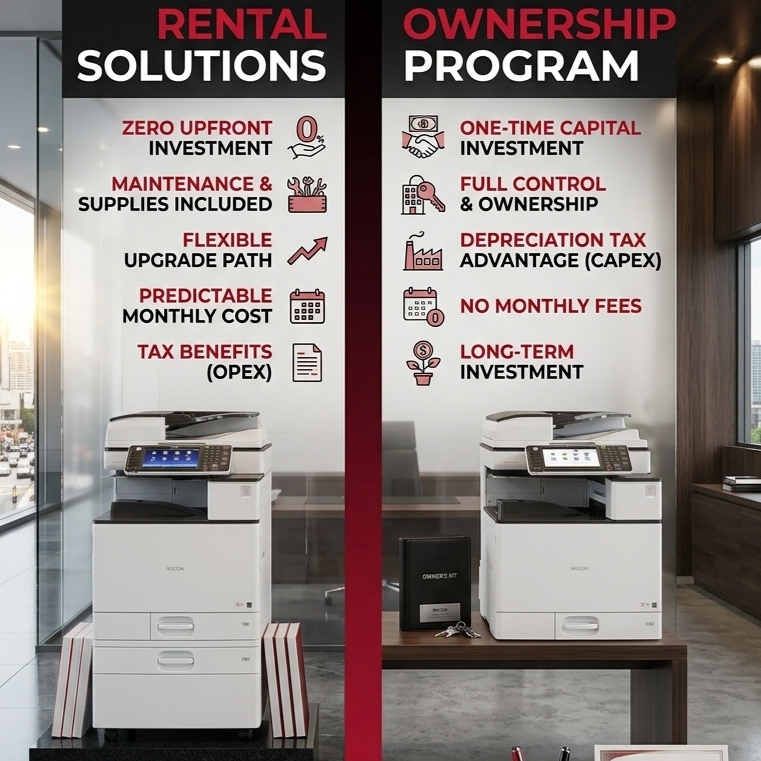
Direct Structural Comparison: Purchasing Outright vs Managed Leasing Framework
FAQs (Frequently Asked Questions)
A managed copier rental structure protects an emerging SME's financial runaway by eliminating large upfront cash drains. It converts volatile, unpredictable maintenance, component repairs, and toner replenishment costs into a single, predictable monthly fee. This makes corporate budgeting simple and stress-free while allowing the business to redirect vital capital toward direct revenue-generating avenues like product development or marketing.
When you rent your print fleet from a dedicated supplier like Telecopier, upgrading your technology is completely seamless. Unlike purchasing—where you are stuck with outdated hardware that has low resale value—a rental framework allows your business to easily transition to a newer model featuring advanced cloud integration and faster print engines at the end of your contract cycle, or as your workflows evolve, without absorbing any capital loss on depreciating hardware.
Business Solutions from Telecopier
To improve your office printing system, you can also explore:
 Lower upfront costs Fixed monthly payments Maintenance included Minimize downtime